
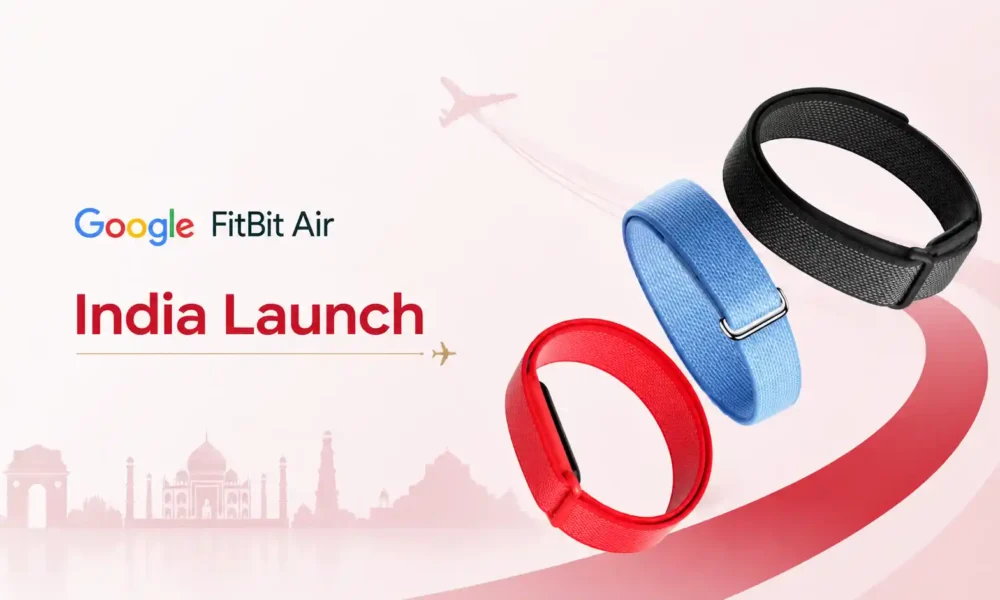
I Don’t know about you, but I hit a breaking point with wrist notifications a few months back. My watch had basically turned into a tiny, buzzing tyrant attached to my arm. A Slack message from my boss, a calendar alert for a meeting in five minutes, an email ping, a random news headline, and—the absolute worst—a passive-aggressive vibration at 9:30 PM reminding me I hadn’t hit my step goal yet. What started years ago as a neat way to track my runs slowly morphed into an overpriced digital leash. That’s exactly why Google Fitbit Air caught my attention.
The premise is almost retro: no screen, no notifications, no glowing glass face keeping you awake at night. Just a paper-thin band sitting on your wrist, silently gathering your heart rate, sleep trends, and recovery data in the background while you actually go out and live your life.
At $99.99 in the US (and £84.99 in the UK), it’s easily the most stripped-down piece of hardware Google has released in years. But does ditching the display actually make for a better health tracker, or is it just too basic to be useful?
Google confirmed that the screen-free Fitbit Air will launch in India in October 2026.
Here’s the unfiltered truth about what it’s actually like to live with it.
What Is It (and What Is It Definitely Not)?
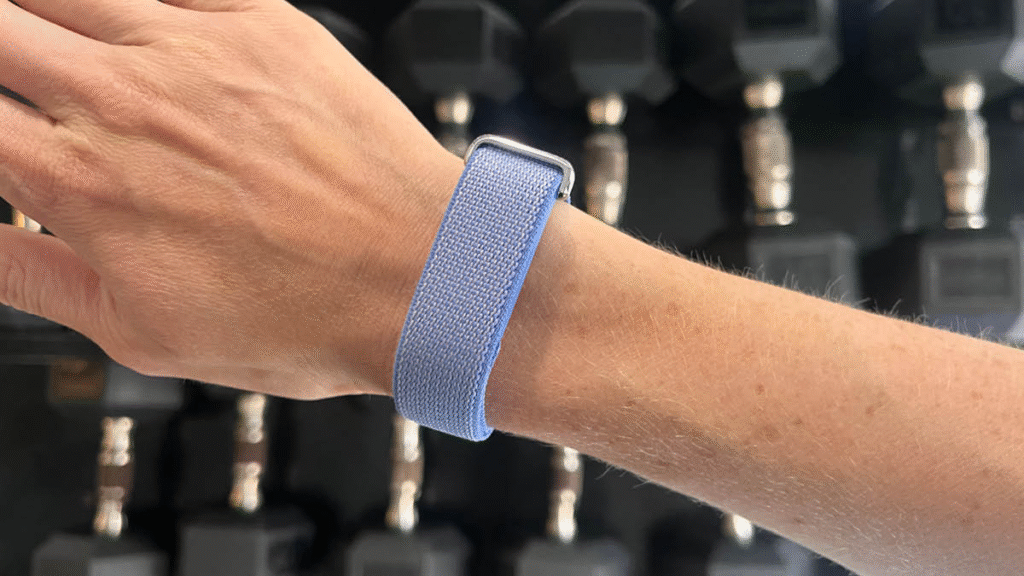
If you open the box expecting a traditional smartwatch, you’re going to do a double-take. The Fitbit Air has zero screen, zero buttons, and no clock. You can’t even check the time on it.
Instead, the whole device centers around a tiny, smooth oval sensor—what Google calls the “pebble.” You just pop that pebble into a lightweight strap, slide it on, and forget about it.
THE “PEBBLE” SETUP
• Weight: 5.2 grams (you genuinely forget it’s there)
• Thickness: 8.3 mm (sits flush against your skin)
• Feedback: A subtle LED dot + double-tap vibrations
↓
Snaps right into
↓
SWAPPABLE BANDS
• Performance Loop (Comfy, micro-adjustable fabric)
• Active Band (Waterproof silicone for heavy workouts)
• Elevated Band (Low-profile, slightly dressier look)
You won’t be glancing at your steps while walking the dog, reading WhatsApp previews, or seeing who’s calling you. All you get on the Google Fitbit Air tracker itself is a single, tiny LED light and a gentle vibration to give you a heads-up when the battery is running low. Every single health stat syncs behind the scenes to your phone over Bluetooth.
And here’s a massive win: Google didn’t wall off iPhone users. It plays totally fine with both iPhones (iOS 16.4+) and Android devices (Android 11+).
The “Forget You’re Wearing It” Test
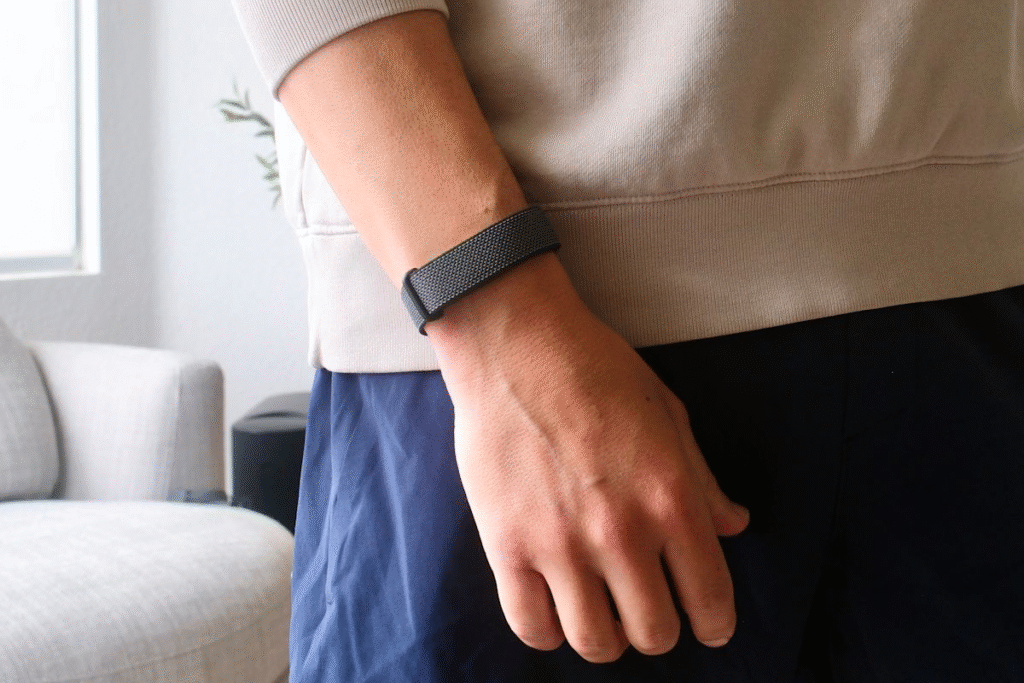
If you’ve ever ripped off a heavy metal or glass watch at 2:00 AM because your wrist felt hot, sweaty, or constricted, this is where the Google Fitbit Air utterly wins you over. Wearable health tracking only works if you actually, well… wear it.
Why It’s So Easy to Live With
- It weighs practically nothing: The core pebble is just 5.2 grams. Even with the default fabric strap, the whole setup weighs 12 grams total. To put that in perspective, two standard quarters in your pocket weigh more than this entire tracker on your arm.
- It stays out of the way: At 8.3 mm thick, it lies completely flat. It doesn’t snag on tight jacket sleeves, and it won’t clack against your desk or dig into your wrist while you’re typing away on a laptop.
- Water isn’t an issue: It carries a 5 ATM (50-meter) water rating. You can jump in the shower, sweat through a brutal cardio session, or swim laps without giving the hardware a second thought.
Under the Hood: Small Profile, Serious Sensors
Don’t let the lack of a display fool you into thinking this is just a glorified $10 step counter. Under the hood, Google packed in the same heavy-duty sensor array you’d find in hardware costing twice as much.
- 24/7 Pulse & Recovery Tracking: It measures your heart rate every two seconds. That constant stream of data feeds directly into your Resting Heart Rate (RHR) and Heart Rate Variability (HRV)—the two numbers that actually tell you if your body is well-rested or desperately needs a day off.
- Passive AFib Safeguards: The FDA-cleared software quietly scans your heart rhythm while you sleep or rest. If it catches irregular patterns linked to Atrial Fibrillation, it flags them inside the app. (Just remember: it’s a passive safety net, not a manual ECG button on demand.)
- Blood Oxygen ($SpO_2$) & Body Temp: It monitors overnight body temperature variations and blood oxygen levels. These subtle background shifts often drop subtle hints about oncoming fatigue, jet lag, or a bug long before you start feeling sick.
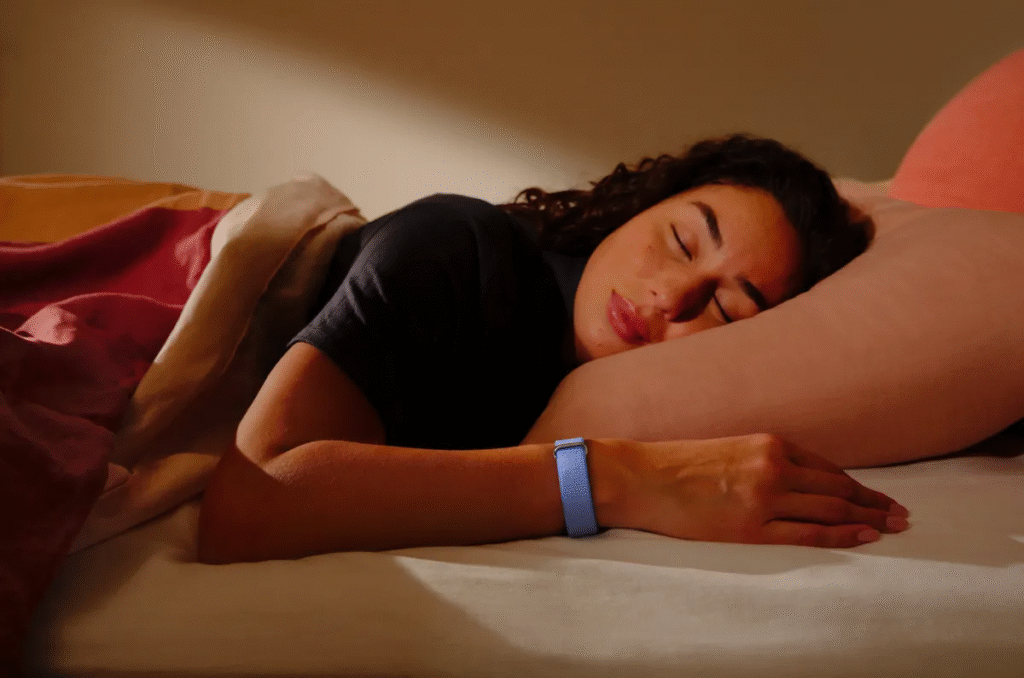
- Sleep Tracking You’ll Actually Keep On: Because 12 grams virtually disappears on your arm, wearing it to bed is effortless. It automatically maps out your Light, Deep, and REM sleep cycles. My favorite feature is Smart Wake—it uses a silent vibration to nudge you awake during your lightest sleep window so you don’t wake up feeling like a zombie.
- Zero-Effort Workout Detection: You don’t have to awkwardly tap through menus before going for a jog. The Google Fitbit Air motion sensors automatically spot when you’re walking, running, cycling, or using an elliptical and log the session for you. Plus, it can broadcast your live heart rate over Bluetooth straight to gym equipment.
Battery Life: Charging Become a Weekly Task, Not a Daily Chore
When you take away a bright, power-hungry screen, Google Fitbit Air battery math gets infinitely better. Instead of burning juice lighting up pixels every time you move your wrist, all that power goes straight into keeping the health sensors running.
- 7-Day Battery: You get a solid week of 24/7 tracking before needing to hunt down a cable.
- Emergency Top-Ups: If you catch the low-battery vibration, a quick 5-minute charge gives you a full 24 hours of tracking.
- Standard USB-C: The oval magnetic dock plugs into standard USB-C, so you don’t have to carry yet another weird, proprietary wall brick when traveling.
The Software: Moving On to Google Health
The Google Fitbit Air also marks a big shift behind the scenes: Google has officially retired the old standalone Fitbit app and moved everything over to the Google Health app.
Section What can you track
• Today Live heart rate, steps, & daily logs
• Fitness Cardio load, readiness, & workout history
• Sleep Stage breakdowns, HRV, & temp baselines
• Health AFib alerts, SpO2, & health records
If you’re a long-time Fitbit user, your entire history migrates over without losing a day. Even better, Google finally fixed a issue that drove users crazy for years: dual-device support. You can now wear a Pixel Watch during the workday for calls and notifications, then swap to the featherlight Google Fitbit Air for bed or workouts without duplicating steps or ruining your streaks.
Gemini AI Health Coaching
Buying the Air gets you a 3-month trial of Google Health Premium, which unlocks the Gemini-powered Google Health Coach:
- Smart Adjustments: It automatically reins in your workout goals when your recovery data shows your body is completely drained.
- Plain-English Answers: You can ask questions in normal human language—like “Why did my recovery score tank on Tuesday?”—and get a clear breakdown based on your sleep quality and stress levels.
- Whiteboard Photo Parsing: If you’re at a gym with a workout written on a whiteboard, you can snap a photo, and the AI will read the text and log the whole routine into your workout diary automatically.
(And for peace of mind: Google explicitly promises that health data inside Google Health is kept totally separate and never used for ad targeting.)
The Verdict: Is It Right for You?
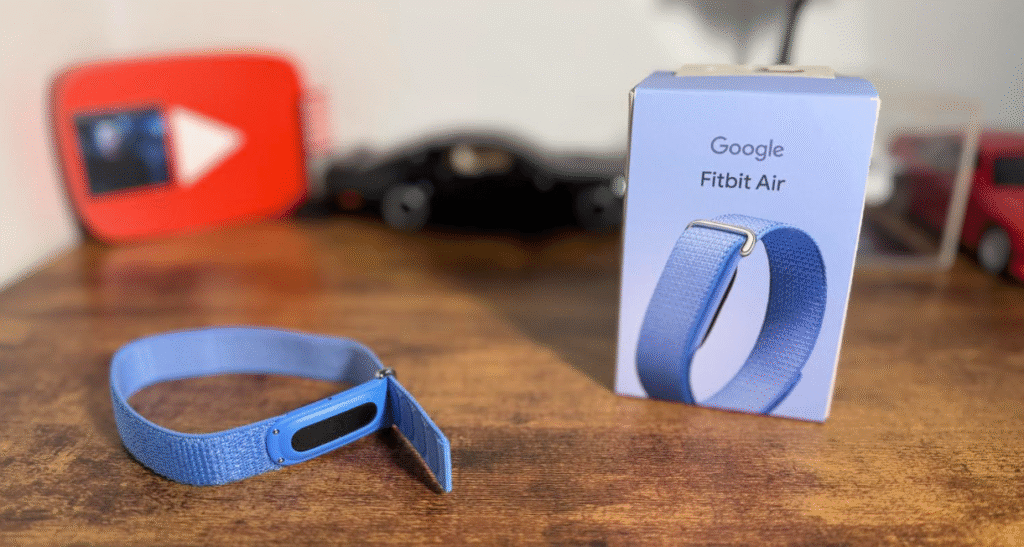
The Google Fitbit Air isn’t trying to be an all-in-one smartwatch—and that total lack of feature creep is honestly its greatest strength.
You’ll probably love it if:
- You are thoroughly burned out on wrist buzzes, flashing screens, and constant notifications.
- You want accurate, uninterrupted sleep data without wearing a bulky block of metal to bed.
- You want a health band that lasts a full week on a single charge.
- You’re an iPhone user who wants a quiet, low-profile health tracker.
You should pass if:
- You want built-in GPS for phone-free outdoor runs (it needs your phone nearby to map routes).
- You rely on your wrist for quick text replies, music controls, or tapping to pay at checkout.
- You need an on-demand, manual ECG feature.
The Google Fitbit Air feels like a breath of fresh air in an industry obsessed with grabbing our attention every five seconds. If you want deep, accurate health metrics without putting another noisy screen in your life, it’s one of the easiest devices to recommend.
FYQ’S
1. Wait, if there’s no screen, how do I actually see my steps?
You just glance at your phone! Open the Google Health app, and all your live heart rate, step counts, and sleep stats are right there waiting for you.
2. I’m an iPhone user… am I gonna get left out in the cold?
Not at all. It works like a charm on iPhones (iOS 16.4+) just as easily as it does on Android, so no need to switch phones.
3. Do I really have to take it off every time I jump in the shower?
Nope, leave it on! It’s rated for 50 meters underwater, so showers, sweaty workouts, and swimming laps won’t hurt it one bit.
4. Am I stuck paying a monthly fee just to get my own health data?
Definitely not. All your core heart, sleep, and activity tracking work 100% free out of the box—the paid plan is just for optional AI coaching stuff.
5. How often am I actually gonna be hunting down the charger?
Barely once a week. You get 7 full days of battery, and if you forget, plugging it in for just 5 minutes gets you through another whole day.