
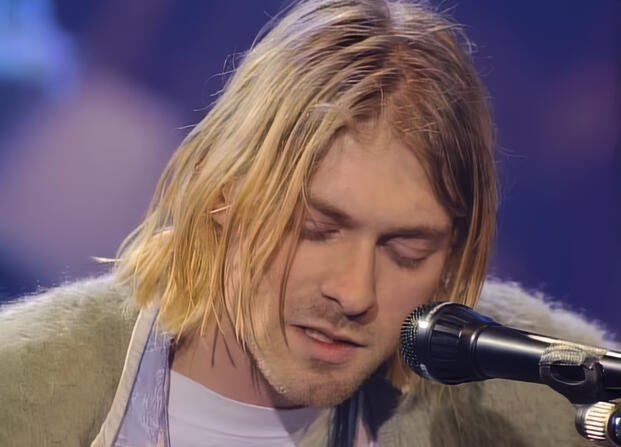
More than three decades after Kurt Cobain was found dead in his Seattle home, a new round of forensic analysis is once again challenging the official conclusion that the Nirvana frontman died by suicide.
For those of us who lived through the early 1990s and are old enough to remember, Cobain’s music was part of the cultural backdrop of that era. His death at age 27 became one of the defining tragedies of a generation. Now, 32 years later, the questions surrounding it continue to echo.
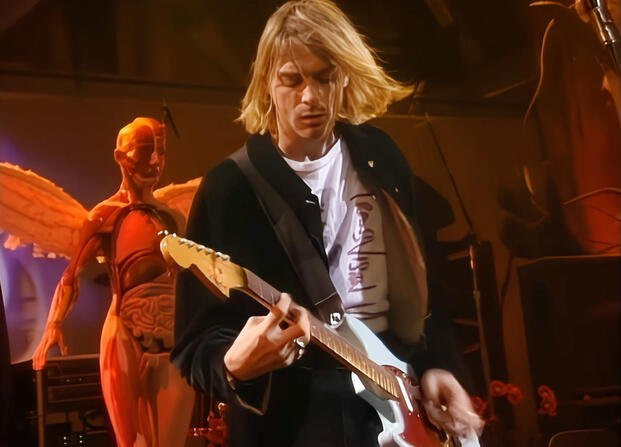
Cobain performs during Nirvana’s “Live and Loud” show at Pier 48 in Seattle in 1993.
What the New Forensic Team Claims
Wilkins, 50, says her interest in Cobain’s death began decades ago after watching the 1998 documentary Kurt and Courtney. Over time, she assembled a team of specialists in firearms analysis, toxicology and questioned documents.
Among them:
- Bryan Burnett, who runs a private forensic laboratory in San Diego.
- Aaron Brudenell, a firearms consultant.
- James Green, a handwriting examiner.
- Several Italian forensic scientists contributed additional analysis.
They also gained support from Mark Larson, a former longtime chief of the criminal division at the King County Prosecutor’s Office, who said he believes the case was “underinvestigated.”
The team says it reviewed publicly available police reports, crime scene photographs, and, crucially, documents not previously widely circulated — including portions of Cobain’s autopsy and a Washington State Patrol firearms review of the Remington Model 11 20-gauge shotgun found at the scene.
Their conclusions challenge several key elements of the original investigation. Among the most significant claims:
- Firearms Operation: The team argues that Cobain could not have operated the shotgun in the manner described by police. According to their report, the design of the weapon would likely have malfunctioned if the barrel were gripped in the way investigators said Cobain held it. The report also questions the lack of blood spatter on Cobain’s left hand, which was reportedly wrapped around the muzzle.
- Toxicology Concerns: The report points to what it describes as an extremely high concentration of heroin in Cobain’s blood. The team contends that such a level would have rendered him unconscious within moments, raising doubts about his ability to then operate a firearm. They further cite what they interpret as evidence of necrosis in Cobain’s liver and brain, which they argue would indicate prolonged circulatory collapse before the gunshot.
- Injection Site Discrepancies: Cobain was left-handed. According to the forensic team’s reading of the autopsy, most of his prior injection sites were located on his right arm. They say the fatal injection appears to have been administered into his left forearm, which they consider inconsistent.
- Possible Body Movement: Blood patterns on Cobain’s clothing, they claim, suggest the body may have been repositioned.
- Witness Allegation: The report references an individual who allegedly claimed to have seen others forcibly inject Cobain prior to his death. According to Wilkins’ team, that person was never interviewed by police.
The cumulative effect of these findings, the authors argue, supports the possibility of homicide. No single item, they acknowledge, constitutes definitive proof. But taken together, they describe the evidence as “overwhelming.”
Law Enforcement Response: “This Is a Closed Case”
Seattle police and the King County Medical Examiner’s Office remain firm in their position.
Cobain’s body was discovered on April 8, 1994, in a loft above a greenhouse at his home in Seattle’s Denny-Blaine neighborhood. Authorities determined he died three days earlier, on April 5, from a shotgun wound to the head.
In 2014, on the 20th anniversary of his death, a cold-case detective conducted a review of the file. That review did not reopen the investigation but reaffirmed the original findings.
Detective Mike Ciesynski said at the time, “It’s a suicide. This is a closed case.”
The department reiterated that stance after Wilkins and Larson presented their findings to Seattle Police leadership in November. Assistant Chief Nicole Powell responded in January, stating that while the department appreciated the engagement, it stands behind both the original investigation and the 2014 review.
The King County Medical Examiner’s Office likewise said it has seen nothing that would warrant reopening the case.
Why the Debate Endures
For many Americans who came of age in the 1990s, Cobain’s death was more than celebrity news. It was a cultural rupture.
Nirvana’s music helped define the grunge movement, which, in turn, reflected a generational mood of disillusionment and emotional rawness. Cobain’s struggles with addiction and mental health became widely known after his death, and his suicide was viewed by many as a tragic but consistent extension of those battles.
At the same time, conspiracy theories have circulated almost since the day his body was found. Books, documentaries and online forums have kept speculation alive for decades. In an era where distrust of institutions often runs high, unresolved questions — even if repeatedly addressed — tend to resurface.
There is also a broader cultural dimension. High-profile deaths that occur suddenly and violently often resist closure in the public imagination. John F. Kennedy. Elvis Presley. Princess Diana. For some, the official explanation never feels sufficient. Mark Larson argues that the speed with which the original investigation concluded suicide may have limited certain forensic avenues that would normally be explored in suspicious deaths.
#KurtCobain #CobainCase #Nirvana #KurtCobainDeath #TrueCrime #Carrerbook #Anslation #CelebrityNews #MusicHistory #RockLegend #JusticeForCobain #UnsolvedMystery #RockMusic #90sMusic #MusicLegends #Investigation #BreakingNews